UA
 RU
 EN
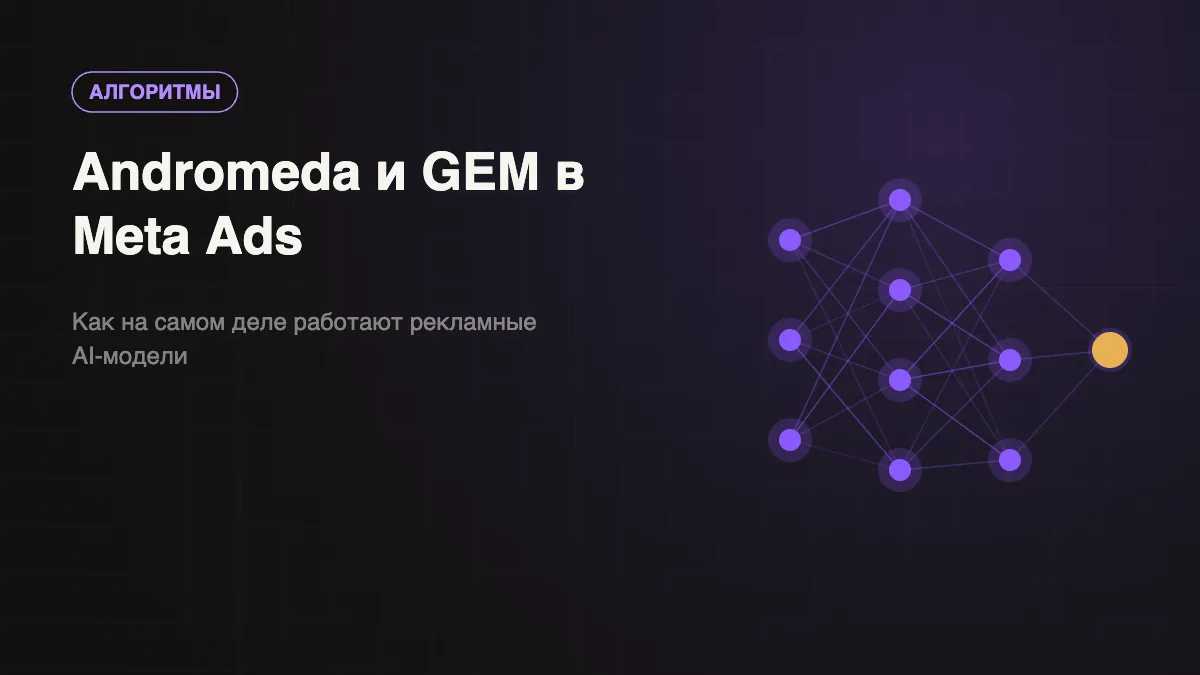
After Meta published technical materials about Andromeda and GEM, a convenient explanation quickly spread through the marketing community: GEM finds the people, and Andromeda decides which ad to show them. For a short post, this model sounds impressive. Technically, it’s inaccurate.
Andromeda and GEM do work within the same ad ecosystem, but they perform different functions and aren’t two competing buttons in Ads Manager. Andromeda is a system for personalized selection of ad candidates at an early stage. GEM is a large foundational recommendation model whose knowledge is passed on to many other models in the ad stack.
To understand their impact on campaigns, you first need to understand the multi-layered ad delivery system.
How Meta chooses an ad for a specific impression
When a user opens Facebook or Instagram, the system has a fraction of a second to pick an ad from a huge number of possible candidates. Checking every ad with the most complex model is impossible — it would be far too slow and expensive.
So the process consists of several layers:
- Determining eligible candidates, taking into account settings, policies, geography and other constraints
- Retrieval — quickly selecting a few thousand relevant ads from tens of millions of candidates
- Further ranking by more complex models that predict the value of the impression for the user and the advertiser
- An auction that takes into account the bid, the predicted likelihood of the desired action and ad quality
- Showing the winner and feeding new behavioral and conversion signals back into the system
This is a simplified diagram, but it’s more accurate than the formula “one AI finds people, the other picks the creative”.
What Andromeda is
Meta introduced Andromeda as a personalized ads retrieval engine. Its job is to efficiently narrow a huge pool of available ads down to a much smaller group of relevant candidates for the next stages.
According to Meta, retrieval is the first stage of a multi-layered recommendation system. It processes orders of magnitude more ads than the later stages and has to work under very tight time constraints.
Andromeda uses deep neural networks, a hierarchical index and Meta and NVIDIA hardware infrastructure. The system learns to detect complex relationships between people’s interests, products, services and ads.
In practice, this means your creative first has to get into the set of candidates the system considers relevant for a specific impression request. Only then do more complex models evaluate it in more detail.
What GEM is
GEM stands for Generative Ads Recommendation Model. Meta calls it a foundational ad recommendation model built on an LLM-like paradigm and trained on a large volume of interactions with ads and organic content.
An important detail: GEM shouldn’t be pictured as a single model that serves every impression on its own. Its knowledge is passed on to other models in the ad stack through knowledge distillation, representation learning and parameter sharing.
GEM works with:
- sequences of user actions
- user and ad attributes
- creative formats and representations
- ad objectives
- clicks, views and conversions
- interactions across Meta’s surfaces
GEM’s job is to improve the whole ad stack’s ability to understand complex patterns and make more accurate predictions.
Andromeda and GEM don’t compete
Andromeda handles scalable early candidate selection. GEM builds deeper knowledge about interactions between users, content and ads and passes it on to other models in the system.
They can’t be meaningfully compared on a “which one matters more” basis. They’re different layers of the same architecture.
A handy analogy:
- Andromeda is a librarian who, in a second, picks a few thousand potentially relevant books out of millions
- Ranking models are experts who evaluate the shorter list in more detail
- GEM is a large knowledge base and teacher that helps these experts understand patterns better
- The auction is the final mechanism that determines the winner based on predicted value and ad conditions
Why broad audiences have become stronger
Meta’s modern models learn from sequences of events, content interactions and large volumes of behavioral data. This lets the system find relevant subgroups within a broad audience without manually listing dozens of interests.
But broad targeting doesn’t mean settings no longer matter. The system still depends on:
- the correct campaign objective
- the chosen optimization event
- budget and bidding strategy
- geographic and legal restrictions
- creative quality and variety
- Pixel and Conversions API data
- real conversions after the impression
A broad audience gives the algorithm freedom. Quality signals determine whether it uses that freedom effectively.
Is the “1 campaign — 1 ad set — 1 creative” structure really the best?
There’s no universal structure that Andromeda always “likes”. Simple campaigns often perform better not because of some secret algorithm preference, but because budget and conversion signals are concentrated.
Meta itself recommends consolidating similar ad sets when excessive fragmentation prevents them from getting enough results for learning. But a single creative also creates a risk of rapid audience fatigue and gives the system no choice between different messages.
A practical approach:
- don’t duplicate identical audiences across many ad sets without a clear hypothesis
- concentrate budget where an ad set can get enough events
- test several genuinely different creative concepts, not ten nearly identical banners
- keep exploring new hypotheses separate from stable scaling
- don’t change the campaign every hour because of short-term fluctuations
In other words, a clean signal doesn’t necessarily mean a single creative. It means a clear objective, a correct event, enough data and a controlled number of variables.
Which signals are critical after Andromeda and GEM
A strong creative
The creative has to explain the product and the reason to pay attention quickly. The algorithm can find a relevant user, but it can’t turn a weak message into a compelling offer.
A clear offer
The offer defines exactly what the person gets, who the solution is for, why it’s relevant now and what the next step is. A vague offer produces vague behavior and weak signals.
The correct optimization event
If the business needs sales but the campaign optimizes for clicks, the system learns to find people who are prone to clicking. That’s not a technical error by the algorithm — it’s the consequence of the task it was given.
A clean Pixel and Conversions API
Duplicates, fake Purchase events, mixed sources and wrong parameters degrade the quality of training data. Fewer real events are better than many events that don’t reflect the business result.
A quality post-click experience
A slow website, a different price, an unexpected redirect or a broken form ruin the user’s journey. The algorithm is responsible for delivery, but conversion depends on the whole funnel.
What to change in your ad strategy
- Build creative concepts, not endless cosmetic variations of one banner
- Send events that are as close as possible to real business value
- Don’t split the budget into structures that can’t accumulate data
- Use broader audiences where geography, the product and legislation allow
- Analyze not only CTR and CPC but also lead quality, sales, margin and return on investment
- Compare campaigns over a sufficient period and account for the learning phase
- Sync ad signals with your CRM and server-side analytics
Conclusion
Andromeda and GEM don’t cancel out marketing. They make mistakes in signals more expensive and strong inputs more valuable.
Andromeda helps quickly select relevant ad candidates. GEM learns from a huge volume of interactions and passes knowledge to the ad system’s models. Further models and the auction evaluate which ad creates the greatest predicted value.
So the advertiser’s main question isn’t “which AI is running Meta now”. It’s this: what data, creatives, events and business outcomes are we giving the system to learn from?
FAQ
What does Andromeda do in Meta Ads?
Andromeda works at the retrieval stage: it selects a few thousand relevant ad candidates from tens of millions of available ads for further ranking.
What does GEM do?
GEM is a foundational ad recommendation model. It learns from large volumes of interactions and passes knowledge to other models in the ad stack.
Has GEM replaced Andromeda?
No. They perform different functions in the same system and can work together.
Should I only run broad audiences now?
No. Broad audiences often give the system more freedom, but results depend on the product, geography, optimization event, budget, data and creatives.
How many creatives should an ad set have?
There’s no universal number. Give the system several meaningfully different concepts, but don’t spread the budget across dozens of barely different variations.
Sources
- Engineering at Meta: Meta Andromeda
- Engineering at Meta: Meta’s Generative Ads Model (GEM)
- Engineering at Meta: Sequence learning for personalized ads
- Meta Business Help Center: About Ad Auctions
- Meta Business Help Center: About managing ad volume
Need a setup tailored to
your project?
We’ll review your current tracking, find where data is being lost and build a setup that works — free of charge.